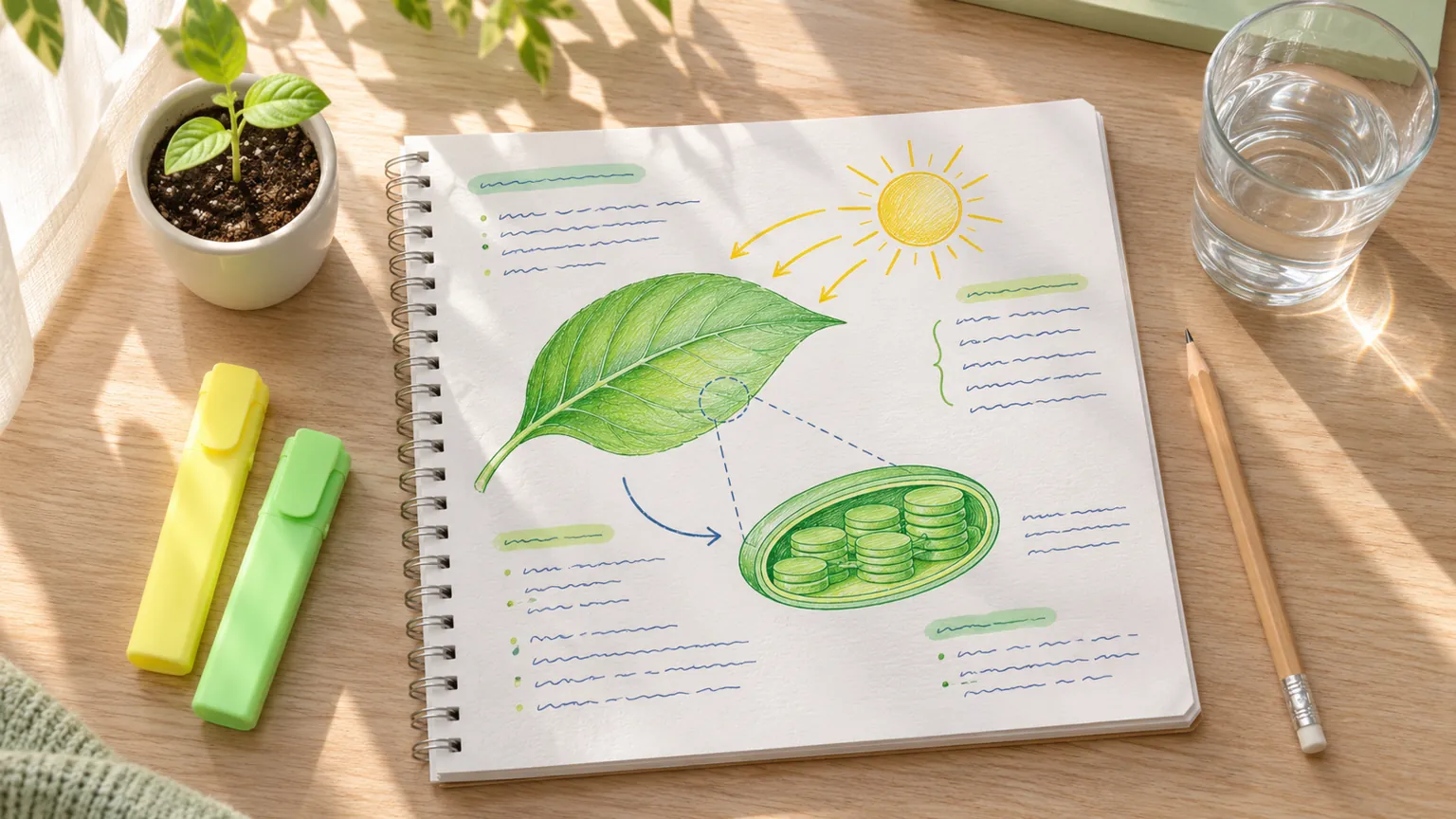
What's in these notes
These photosynthesis notes fit everything you need for a test on one page: the word and symbol equations, a diagram of the two stages, the limiting factors, how a leaf is adapted, the mistakes that lose marks and a five-question quick check with answers. Read them on screen, print them, or download the free PDF.
How to use these notes
- Read the sheet once, then cover it and write out the two equations from memory.
- Do the quick check at the bottom without looking. Any you miss, read the full guide linked below.
- Test yourself with the photosynthesis quiz. Questions you get wrong come back on your Test me page a few days later, so they stick.
Cluecub · Revision notes
Photosynthesis notes
What it is
- Plants, algae and some bacteria make glucose from carbon dioxide and water, using light energy.
- It is endothermic: energy from light is taken in and stored in glucose.
- In plants and algae it happens in , mostly in the palisade cells of leaves.
- Chlorophyll absorbs mostly red and blue light and reflects green.
The two stages
- Light-dependent reactions ( membranes): light splits water, oxygen is released, and and are made.
- Calvin cycle (): uses ATP and NADPH to turn CO2 into sugar. The is .
- The oxygen released comes from water, not from carbon dioxide.
In and out of the leaf
- CO2 in through the ; O2 diffuses out.
- Water comes from the roots through the .
- Guard cells open and close the stomata.
- Glucose is used for respiration, or turned into starch (storage), cellulose (cell walls), sucrose (transport) and proteins and fats.
Limiting factors
- Light intensity, CO2 concentration and temperature limit the rate. Whichever is in shortest supply is the limiting factor.
- Light intensity falls with distance: intensity ∝ 1 ÷ distance² (the inverse square law).
- Too hot and the enzymes are damaged, so the rate falls.
How a leaf is adapted
- Broad and thin: a big surface for light, and a short path for gases.
- Palisade cells packed with chloroplasts near the top surface.
- Air spaces in the spongy layer let gases move between cells.
- Veins bring water (xylem) and carry sugar away (phloem).
Mistakes that lose marks
- Plants respire all the time, day and night, not just in the dark.
- Most of a plant's mass comes from CO2 in the air, not from the soil.
- The Calvin cycle doesn't need darkness. "Dark reactions" is a misleading old name.
- Glucose is the product. Starch is only how it is stored.
Quick check
- Where in the chloroplast do the light-dependent reactions happen?
- Which gas is released as a by-product?
- Name the three main limiting factors.
- Why does the rate fall when it gets too hot?
- What is glucose turned into for storage?
Answers: 1. On the thylakoid membranes. 2. Oxygen. 3. Light intensity, carbon dioxide concentration, temperature. 4. The enzymes are damaged (denatured). 5. Starch.
Free from www.cluecub.com/photosynthesis-notes · Check every fact in the full guides on the site.
Go deeper
Each box on the sheet has a full guide with diagrams and practice questions:
- What is photosynthesis? and the photosynthesis equation
- The light-dependent reactions and the Calvin cycle
- Where does photosynthesis take place?, stomata and chlorophyll
Frequently asked questions
Are these photosynthesis notes free?
Yes. You can read them here, print them or download the PDF for free, for yourself or for a class.
What level are these notes for?
They cover photosynthesis for middle school, high school, GCSE and AP biology. The two stages (light-dependent reactions and the Calvin cycle) go a little beyond what younger students need.
How should I revise photosynthesis?
Learn the two equations first, then the two stages and the limiting factors. Then test yourself: retrieval practice works far better than re-reading. Our quiz brings back the questions you miss a few days later.