What's in these notes
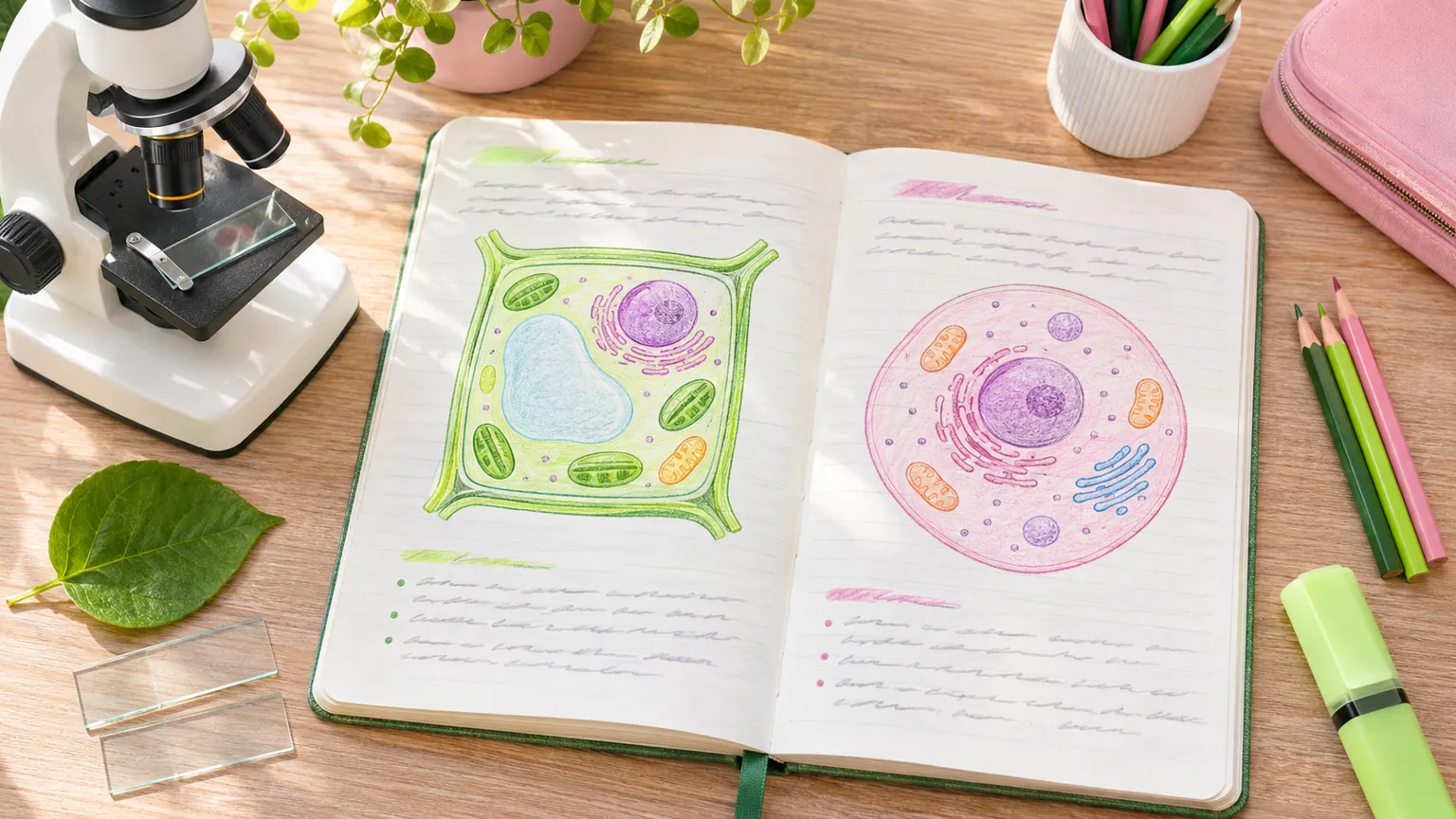
These plant and animal cell notes fit on one page: both labelled diagrams, the job of every part, the three parts only plant cells have, microscope maths, the mistakes that lose marks and a five-question quick check with answers. Read them here, print them, or download the free PDF.
How to use these notes
- Read the sheet once, then cover the diagrams and label a blank cell from memory.
- Do the quick check at the bottom without looking. Any you miss, read the full guide linked below.
- Explore the cells in 3D on the plant cell diagram page, then answer its questions. Questions you get wrong come back on your Test me page a few days later.
Cluecub · Revision notes
Plant and animal cells notes
Parts in both plant and animal cells
- Nucleus: holds the DNA and controls the cell.
- : jelly-like fluid where many reactions happen.
- Cell membrane: controls what goes in and out.
- : where releases energy.
- Ribosomes: where proteins are made.
- ER and Golgi: make, package and send out proteins and lipids.
Only in plant cells
- Cell wall: made of . Supports the cell and keeps its shape.
- : contain . Photosynthesis happens here.
- Permanent vacuole: filled with cell sap. Keeps the cell firm.
Usually only in animal cells
- Lysosomes: small sacs of digestive that break down waste.
- Centrioles: help the cell divide.
Size and microscope maths
- Animal cells are about 10 to 30 µm across; plant cells about 10 to 100 µm.
- 1 mm = 1000 µm.
- Magnification = image size ÷ actual size. Use the same units for both.
Eukaryotic and prokaryotic
- Plant and animal cells are eukaryotic: their DNA is inside a nucleus.
- Bacteria are prokaryotic: no nucleus, a loop of DNA and often small rings called plasmids. They are much smaller.
Mistakes that lose marks
- Plant cells have a cell wall and a cell membrane, not one instead of the other.
- Mitochondria are in plant cells too. Plants respire as well as photosynthesise.
- Not every plant cell has chloroplasts: root cells don't, because no light reaches them.
- The cell wall is fully permeable. The membrane is what controls entry.
Quick check
- Name the three parts found only in plant cells.
- What is the plant cell wall made of?
- Where in the cell are proteins made?
- Write the formula for magnification.
- Why don't root cells have chloroplasts?
Answers: 1. Cell wall, chloroplasts, permanent vacuole. 2. Cellulose. 3. On the ribosomes. 4. Image size ÷ actual size. 5. No light reaches them, so they can't photosynthesise.
Free from www.cluecub.com/plant-and-animal-cells-notes · Check every fact in the full guides on the site.
Go deeper
Each part of the sheet has a full guide with diagrams, a 3D model and practice questions:
Frequently asked questions
Are these cell notes free?
Yes. You can read them here, print them or download the PDF for free, for yourself or for a class.
What level are these notes for?
They cover plant and animal cells for middle school, high school and GCSE biology, including the microscope maths that often comes up in tests.
How should I revise plant and animal cells?
Practise labelling a blank diagram from memory, then learn the job of each part and the three parts only plant cells have. Testing yourself works far better than re-reading.